The Wicomico, Nanticoke, Wetipquin, Quantico, and Rewastico were not simply scenic features beside local communities. They were roads and workplaces, and they were where generations learned how to read tide, wind, bottom, channel, fish, crab, and season.
Compiled for Wicomico County MDGenWeb, August 2026
Before Wicomico County Had a Name
For thousands of years before European settlement, Indigenous communities used the Lower Eastern Shore’s rivers, marshes, and estuaries for transportation, fishing, shellfish gathering, hunting, and trade. The Pocomoke people occupied a region that included parts of modern Wicomico, while the Nanticoke world centered on the river that still bears that name and the Assateague lived to the east. Across the Chesapeake, dugout canoes were essential fishing and travel craft, and nets were made from cordage produced from bark and plant fibers.
That earlier water knowledge matters in Wicomico because European settlers did not discover an unused landscape. They entered a country whose channels, fish runs, marsh resources, and routes were already known. Even the later Chesapeake log canoe carried forward Indigenous dugout technology, enlarged and adapted by local boatbuilders.
For Supper and for Sale
Colonial fishing was initially much more about feeding households than supplying an industry. Hook and line took perch, striped bass, catfish, drum, and other fish; oysters and blue crabs were local foods long before refrigerated cars could carry them to distant customers. The same distinction persisted well into modern times. A man listed as a farmer might still fish a creek, a waterman might keep part of his catch, and a child with a dip net might contribute directly to supper without ever appearing in a record as a fisherman.
This is where the image of boys in little skiffs belongs. They were not necessarily “sport fishing” in the modern sense. They might be having a grand time, but they were also learning the water: where a creek narrowed, where the tide left a mudflat, where crabs held, where a turtle trap could be set, and how quickly a summer squall could erase the pleasant afternoon they had planned. The Eastern Shore word turkling preserves one piece of that world of turtle trapping and marsh knowledge.
The Great Wicomico River Shad Fishery
Oysters dominate modern memory of Chesapeake watermen, but Wicomico also supported a major commercial finfish fishery. A federal fisheries survey reported an extraordinary shad catch from the Wicomico River in 1896: about 244,577 pounds . Drift gill nets took most of it. Fishermen worked those nets from White Haven upstream to about a mile below Salisbury, while pound nets operated near White Haven and other fixed and hauled nets worked different parts of the river.
The gear shows how precisely fishing methods matched water. A drift net moved with the current from a small boat. Stake nets depended on fixed locations. Pound nets guided migrating fish through a leader into an enclosure. Seines could sweep shallower reaches. None of these methods was random. A successful fisherman had to know where migrating shad traveled, how river current behaved, and when the spring run had truly begun rather than merely been rumored at the store.
Shad also show the overlap between commerce and food. The large catch could be sold, salted, or shipped; smaller catches and other species taken in the same gear fed local households. The river could be a market and a pantry on the same day.
Oysters, Waltersville, and Bivalve
On the lower West Side, oystering became so important that it renamed a community. Waltersville became Bivalve after Elrick Willing , appointed postmaster in 1887, selected a name taken directly from the shellfish around which local life increasingly revolved. Families including the Larmores, Insleys, Messicks, Harringtons, Willings, Dunns, and Horners appear in local accounts of a place where many men “lived on the water.”
Some sailed schooners, bugeyes, and bateaux between regional ports; many more tonged oysters. Older Bivalve history remembered a season running from early September through April, followed by farming and other work in warmer months. The oyster did not replace agriculture so much as interlock with it. One household might have fields behind the house and oyster tongs aboard the boat.
The river linked work to institutions. When Bivalve’s Methodist Protestant Church was erected in the 1880s, building materials traveled by water. Local tradition remembered the church bell arriving aboard the schooner Speed , then moving by log canoe before a group of watermen raised it into place. Even church construction depended on the transportation system the watermen knew best.
Nanticoke: Wild Bars, Private Leases, and H. B. Kennerly
Wicomico developed an oyster economy unlike much of Maryland because private oyster leases became unusually important in the Nanticoke and Wicomico rivers. The H. B. Kennerly Company at Nanticoke encouraged local watermen to lease bottom, supplied shell from its shucking operation as substrate, and bought the mature oysters back. A waterman could work public bars during the regular season, tend leased oysters afterward, then shift into crabbing as warm weather arrived.
The arrangement created a distinctive annual rhythm and survived well into the twentieth century. Later watermen remembered it personally. Mike Lindemon recalled winter oyster work in the Nanticoke, while Bill Denherder described a cycle that moved from public oysters to finfish, private leased oysters, and then crabbing. Eric Wisner , from a later generation, worked an extensive group of oyster leases and adapted a houseboat for dredging. These are not three identical careers; together they show how Wicomico watermen kept modifying old knowledge to fit new markets and regulations.
Boats, Wharves, and Boatbuilders
Wicomico’s watermen used the great Chesapeake family of craft: dugout-derived log canoes, bateaux, schooners, bugeyes, skiffs, and eventually powered deadrise workboats. Different work demanded different boats. Tonging rewarded shallow draft and stability. Freight demanded carrying capacity. Net fishing needed a boat easy to maneuver around gear. Crabbing rewarded an open working deck and reliable engine.
Local waterways also supported boatbuilding. Stephen Wright of the Wetipquin community, born about 1769, was a free Black carpenter and shipbuilder as well as a literate landowner. Farther upstream and around Barren Creek and the Nanticoke, small yards built and repaired the craft by which the countryside reached the outside world.
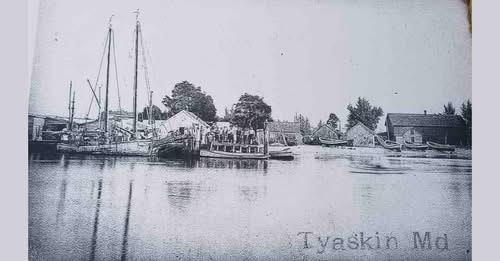
Wharves at Tyaskin, Nanticoke, Bivalve, and White Haven were the transfer points. A boat could arrive with oysters and leave with manufactured goods; a steamer could carry passengers, produce, mail, and news. The waterman’s workplace was therefore part of a much larger transportation economy.
Learning the Water: Frank Wright and the Hidden Apprenticeship
Few surviving records illustrate the boy-to-waterman progression better than the Smithsonian oral history of Frank Wright , collected in Hebron. Wright was a third-generation Black waterman. His earliest memories included going out on the oyster boat with his father, Ira Wright . He learned first to cull oysters and then to tong. That sequence matters: the boy did not begin by being handed the most difficult tool. He watched, sorted, carried, learned, and gradually took on the work.
The Wright family did not depend on a single occupation. Their life included oystering, crabbing, fishing, farming, and a family store. Frank remembered Black watermen helping one another and described relationships across racial lines as well as the realities of segregated life. His later life as a teacher and storeowner did not erase the waterman knowledge learned in childhood.
That is the human meaning of “knowing every nook and cranny.” A chart can mark a creek. It cannot teach the sound of a boat touching bottom, the feel of a tide turning under a net, or which apparently open shortcut will leave a skiff sitting in mud. Those things are learned by repetition, usually beside somebody who already knows.
Black Watermen in Wicomico Records
Marriage records created after emancipation put names to men whose work might otherwise disappear into a general phrase such as “colored labor.” In the late 1860s and early 1870s, Wicomico records identify Levin Conway , William Broxson , Henry Nutter Jr. , Wesley Elzey , and Dennis Jones as Black or colored oystermen. Several were connected with Nanticoke Point and the lower county water communities.
These men worked the same weather and oyster bottoms as white watermen, but they did not work in an equal society. Black families built their own churches, schools, landholdings, and mutual-support networks while confronting segregation and discrimination. Yet the maritime record also shows expertise and persistence. The waterman history of Wicomico is incomplete if their names remain outside it.
A Year Was a Chain of Seasons
Commercial fishing was only one part of household survival. Gardens, corn, poultry, small livestock, seasonal farm wages, seafood work, stores, and boat work could all coexist. The West Side in particular joined fields and water so closely that “farmer” and “waterman” can be misleading if treated as mutually exclusive identities.
Women’s work tied those seasonal pieces together. They kept households, gardens, stores, accounts, and food preservation moving while men were away on the river; many also worked directly with seafood. Children helped according to age and family need. The household was the economic unit even when the occupational label belonged to one man.
The Water Could Take People Too
The familiar creek could be dangerous precisely because people used it so casually and so often. On Christmas Day 1832, several young people attempted to cross Wetipquin Creek in a canoe. George L. Walter , his sister Ann Maria Walter , and Adeline Jones , daughter of Capt. Marcellus Jones, drowned; Sarah Jones and Rufus Dashiell survived. They were not commercial fishermen at work, but their deaths belong in water history because the creek was an ordinary road.
Working water added more hazards: winter cold, moving nets, heavy oyster gear, fog, darkness, engine trouble, sudden squalls, and the temptation to keep working because a day ashore earned nothing. A seasoned waterman knew the danger. He also knew that weather, markets, and family needs did not always permit perfect caution.
From Sail and Shad to Engines and Managed Fisheries
By the twentieth century, the Wicomico waterman’s world was changing quickly. Engines replaced most sail. Crab pots overtook trotlines as the dominant commercial method. Nylon transformed nets. Trucks replaced much of the old steamboat and rail distribution. Oyster disease devastated stocks in the second half of the century. Striped bass closures and other regulations forced fishermen to change species or temporarily leave a fishery.
The old commercial shad harvest likewise collapsed from nineteenth-century abundance. In the Nanticoke oyster business, leased-bottom production that once helped sustain a year-round packing industry diminished. Some watermen went into construction, farming, factories, or other work; some combined jobs with part-time fishing.
But the central skill remained stubbornly local. The river could be charted more accurately, engines could become more dependable, and weather forecasts could arrive by radio and telephone, yet a person still had to learn where he was. Wicomico water history is therefore not only a story of what people caught. It is the story of accumulated attention to a landscape of moving water.
Sources and Further Reading
- National Park Service, “Life in the Indigenous Chesapeake” .
- Maryland State Archives, Native Americans in Maryland .
- Jim Casey, “A Short History of Commercial Fishing in the Chesapeake Region,” Maryland DNR .
- U.S. Fish and Wildlife Service / federal fisheries report, historical shad fisheries of the Pocomoke and Wicomico rivers .
- Wicomico County MDGenWeb, “Bivalve, Maryland” .
- Wicomico County MDGenWeb, “Down the West Side” , for Wetipquin, Tyaskin, Bivalve, White Haven, river transport, and local families.
- Don Webster, historical background on Maryland oyster culture and Wicomico’s leased grounds, University of Maryland Extension .
- Maryland Sea Grant, Chesapeake Quarterly , Nanticoke oyster leases and watermen .
- Smithsonian National Museum of African American History and Culture, Frank Wright oral history .
- Enduring Connections, Edward H. Nabb Research Center , for Lower Shore marriage, census, and vital records identifying Black watermen.